December 2025

Market Update

Transportation Trends

General Outlook

  • Colder weather and the Christmas season will have an impact on the freight market.
  • Capacity continues to tighten.
  • Tariff-related delays may impact production, putting pressure on prices.
  • Retail spending up to 4.53%
  • Labor market:
    • Unemployment increased to 4.46% in November.
    • Healthcare and social assistance sectors remain strong.
  • 30-year fixed mortgage is at 6.26% in December.
  • 15-year fixed mortgage is at 5.37%-5.63%.

LTL

  • Current Market
    • ODFL experienced a drop of 10% in tonnage in November, XPO was down 5.4%.
    • Saia and ABF reported modest increases of 1.8% and 3%.
    • Demand is still having an impact on outbound volume, however many carriers like ODFL and ABF maintain strict yield strategies.
    • NMFC reclassification updates are changing the LTL pricing is shifting to more of a density-based program.
    • It is very important to get a better understanding of your dimensions to avoid additional cost.
  • Key Takeaways
    • Look to lock in contractual pricing were appropriate.
    • Review your packaging and dimensions to take advantage of the density-based pricing.
    • Continue to build carrier relationships as the market continues to make changes.
    • Invest or partner with a company to better utilize automation to help control cost.

Truckload

  • Current Market
    • Capacity continues to tighten for the TL market.
      • Tender Rejection by Mode:
        • Van rose 7%
        • Reefer rose 14-15%
        • Flatbed rose 13-14%
      • Freight volume down 6% in 2025 and 4% in December.
        • Rates continue to remain strong based on the capacity in the market.
  • Key Takeaways
    • The TL market is at risk due to increased costs and lack of capacity.
    • Technology will be key to driving compliance with core carriers.
    • Start your planning now! Find a partner that can provide you with technology, visibility, and sustainability in a volatile market.

SONAR

Dark dashboard cards showing truckload and intermodal metrics, including spot and contract rates, with MoM and YoY percentage changes and brief market insights.
Dark dashboard cards showing truckload, intermodal, and ocean volume metrics with WoW percentage declines and short notes on holiday surge and seasonal tapering.

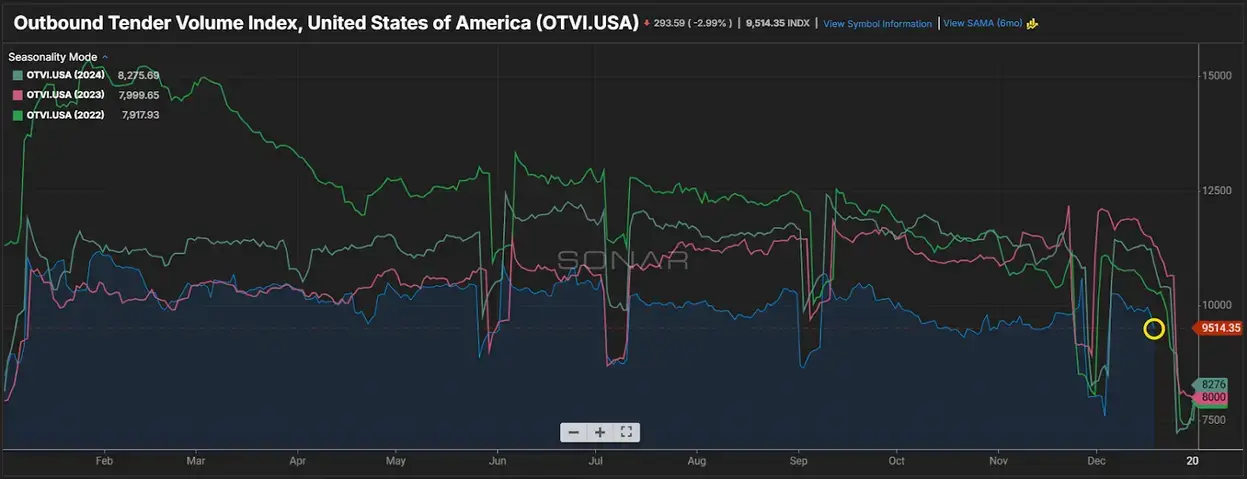
Outbound Tender Volume - All Modes

  • Outbound tender volume drop, but capacity remains tight in the market. Volume continues to ride below historic trends.
Outbound Tender Volume Index Trends Across Multiple Years Line chart showing U.S. outbound tender volume index comparing 2022, 2023, and 2024, with seasonal dips midyear and a sharp decline in December highlighted.

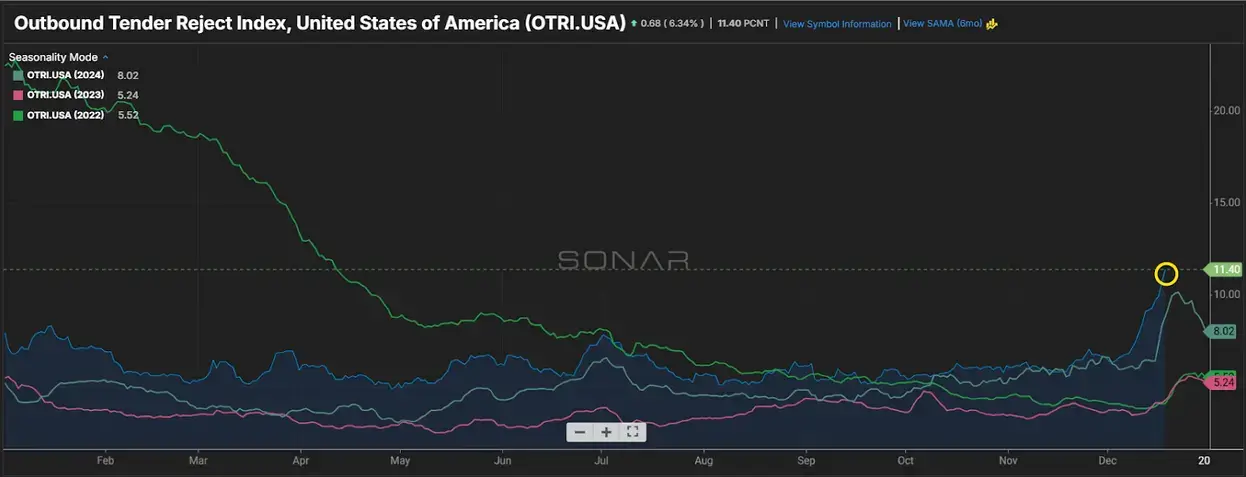
Outbound Tender Reject - All Modes

  • Overall Rejects spike as we head into the final weeks of December. 
    • Capacity has had a large impact on the rejections, despite the overall volume in 2025 being down vs. historical trends.
Outbound Tender Reject Index Trends Across Multiple Years Line chart showing U.S. outbound tender reject index for 2022, 2023, and 2024, with steady declines through midyear and a sharp spike in December highlighted.

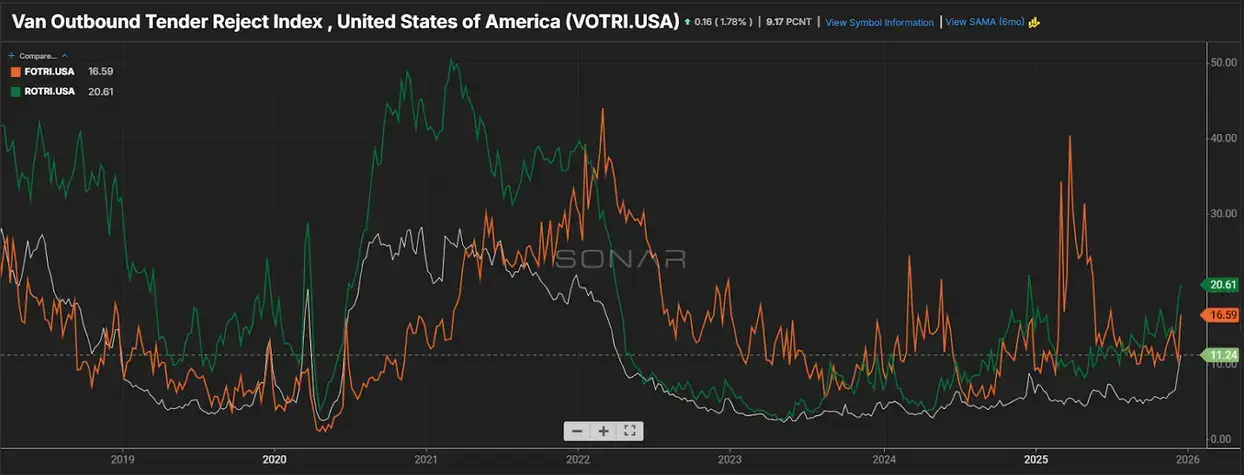
Outbound Tender Reject – by Mode

  • Orange Line – Flatbed: Rejections up vs. this same time last year.
    • Very important to keep a close eye on the overall outbound volume to insure you are securing capacity in this market.
  • Green line – Reefer: Rejections for Reefer up significantly this month vs. last month.
    • Similar to flatbed, increased outbound volume will have a significant impact on capacity in the Reefer space.
  • White line – Van: Van Rejections remain up this month vs. last month. 
    • Rejections continue to fluctuate month- over-month but remain flat since the start of this year. 
Van vs Flatbed Outbound Tender Reject Index Comparison Line chart comparing U.S. van and flatbed outbound tender reject indices over multiple years, showing volatility peaks in 2021–2022 and lower, fluctuating rejection rates through 2025.

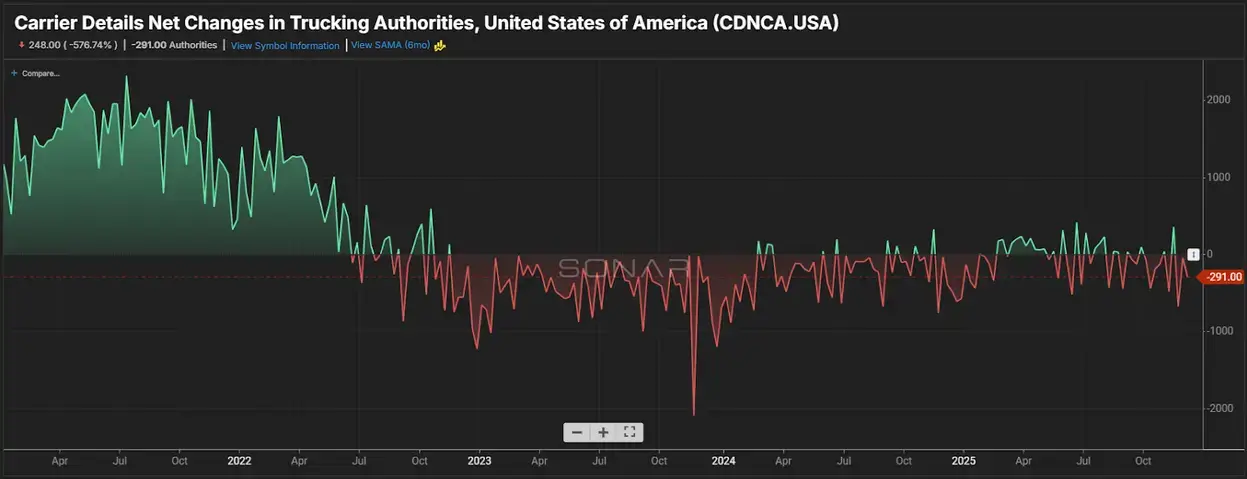
Carrier Authorities

  • This graph indicates we have less transportation companies coming into the market based on the current demand.
    • Authorities continue to drop which is causing rejections to increase despite the overall volume decrease compared to 2024. 
Net Changes in U.S. Trucking Carrier Authorities Over Time Time-series chart showing monthly net changes in U.S. trucking authorities, shifting from positive growth in 2022 to sustained net losses through 2024–2025.

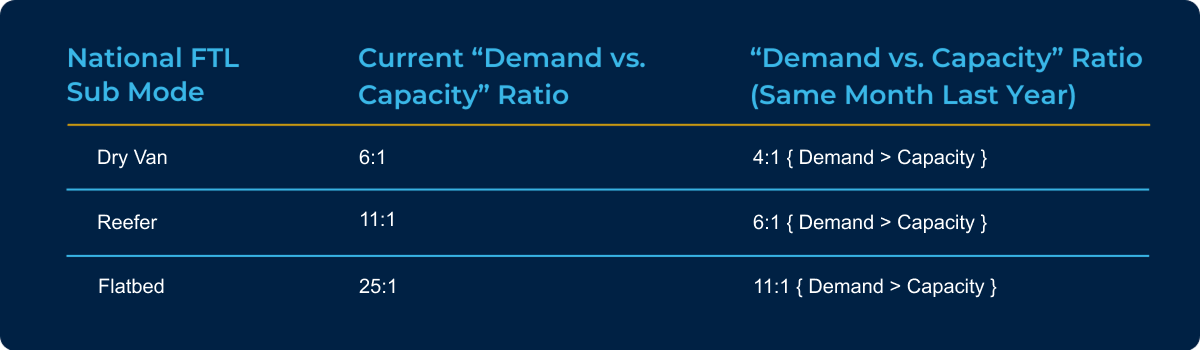
Demand vs. Capacity Metrics - October 2025

National FTL Demand vs Capacity Ratio by Equipment Type Table comparing dry van, reefer, and flatbed demand-to-capacity ratios, showing higher current demand pressure versus the same month last year across all modes.

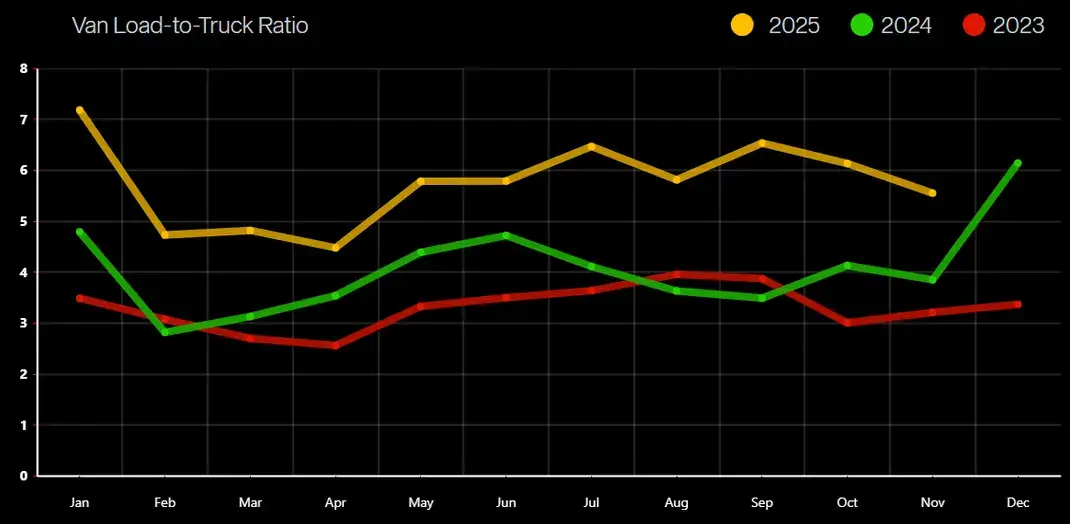
Van Load-to-Truck Ratio

Van Load-to-Truck Ratio Trends by Year (2023–2025) Line chart comparing monthly van load-to-truck ratios for 2023, 2024, and 2025, showing consistently higher ratios in 2025 with midyear peaks and year-end strength.

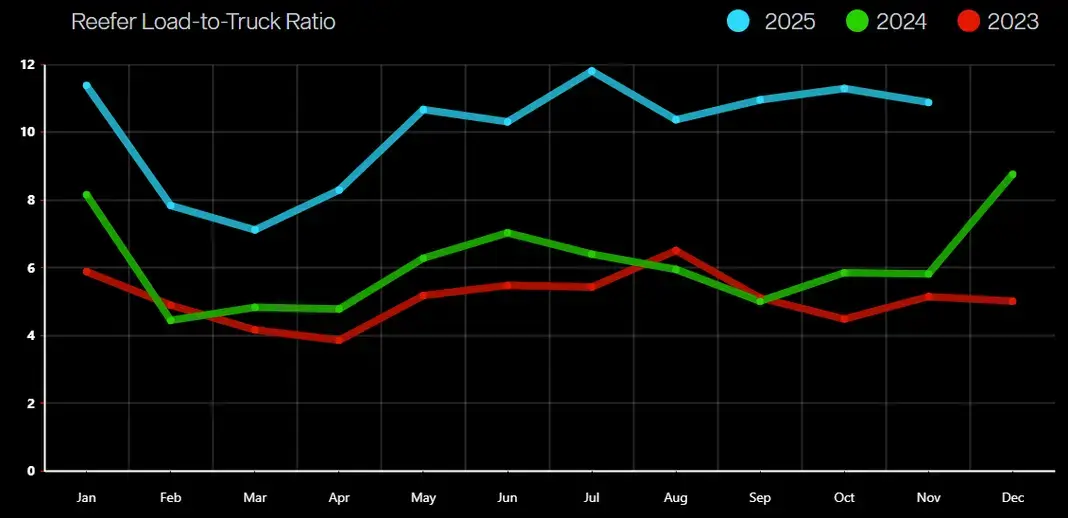
Reefer Load-to-Truck Ratio

Reefer Load-to-Truck Ratio Trends by Year (2023–2025) Line chart showing monthly reefer load-to-truck ratios for 2023, 2024, and 2025, with 2025 consistently highest, peaking midyear and staying elevated into year-end.

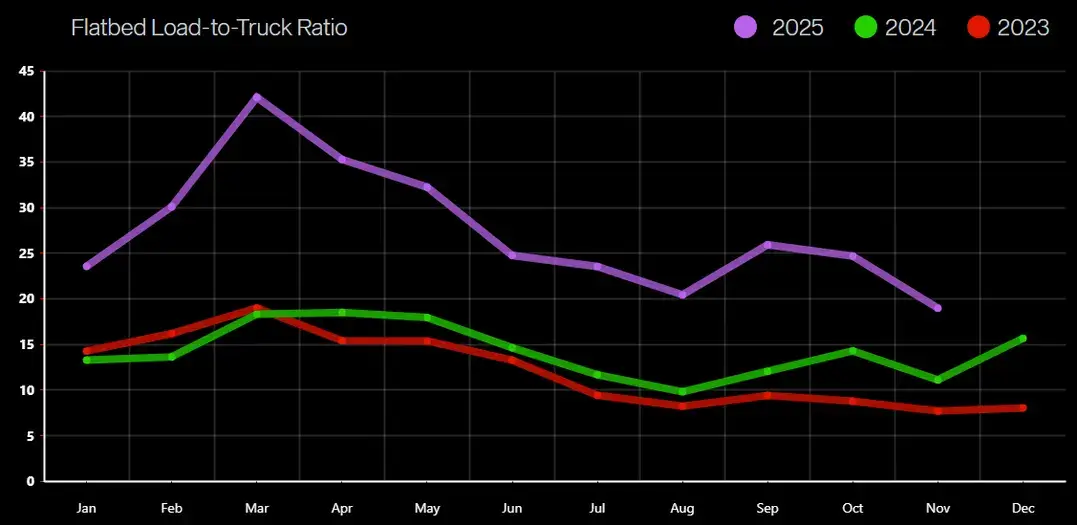
Flatbed Load-to-Truck Ratio

Flatbed Load-to-Truck Ratio Trends by Year (2023–2025) Line chart comparing monthly flatbed load-to-truck ratios for 2023, 2024, and 2025, showing much higher volatility and peaks in 2025, with a sharp spring surge and late-year easing.

International

    • Current Market
      • Overall global demand remained weak across most major trade lanes.
      •  Inbound ocean rates remain soft as outbound rates see a slight uplift.
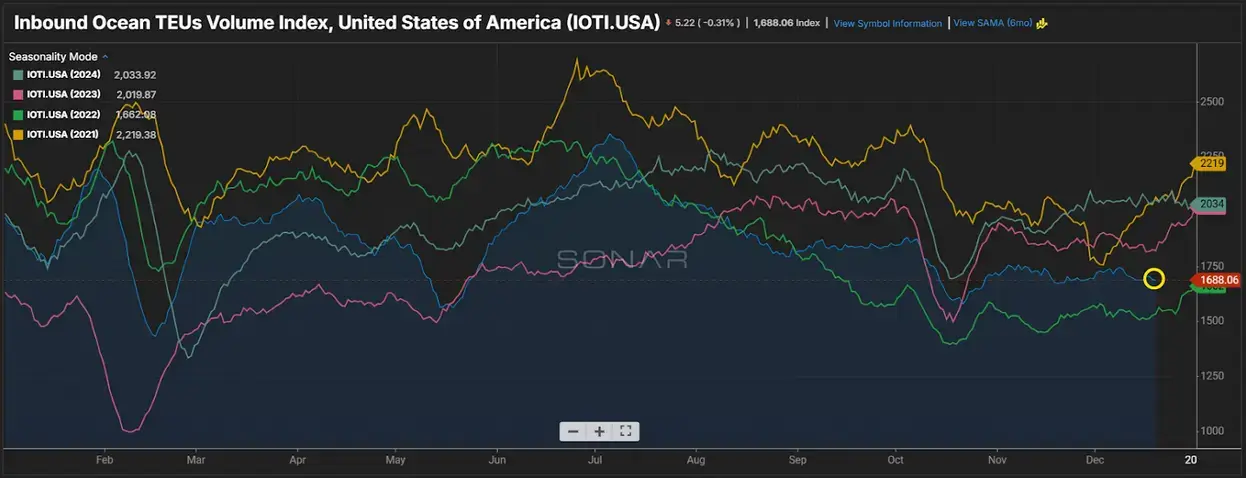
      • U.S. container imports reached its lowest level since mid-2023 in December.
        • Tariffs remain the uncertainty in this space causing the drop.
    • Key Takeaways
      • Secure space early when moving ocean freight to help control the cost.
        • Consider mini bids to help control the volatility of the market.
      • Factor in tariff-driven cost that are having an impact on heavy international lanes.


Inbound Ocean TEU Volume Index Seasonal Trends Line chart comparing U.S. inbound ocean TEU volume index across multiple years, showing seasonal peaks midyear and a sharp drop in October before partial recovery.

Cross Border

  • Major road closures across 17 states in Mexico causing disruptions in freight corridors.
  • Freight rates remain stable overall despite the issues in Mexico.
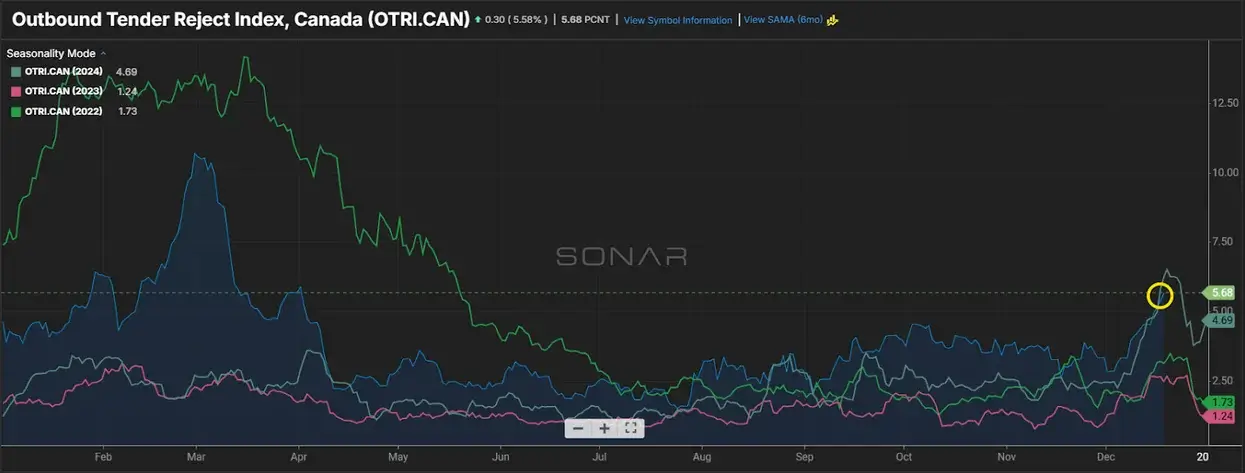
  • Weather in Canada causing issues on the rail and slower traffic in general.
  • Canadian cross board freight despite the weather remains steady.
  • Rates generally stable but U.S. capacity issues could have an impact on pricing as we head into the end of the year.
Outbound Tender Reject Index Canada Seasonal Trend (OTRI.CAN) Dark-themed line chart comparing Canada’s Outbound Tender Reject Index for 2022–2024, showing seasonal declines midyear and a sharp rise in December with the current value highlighted around 5.68.

Fuel Forecast - DOE

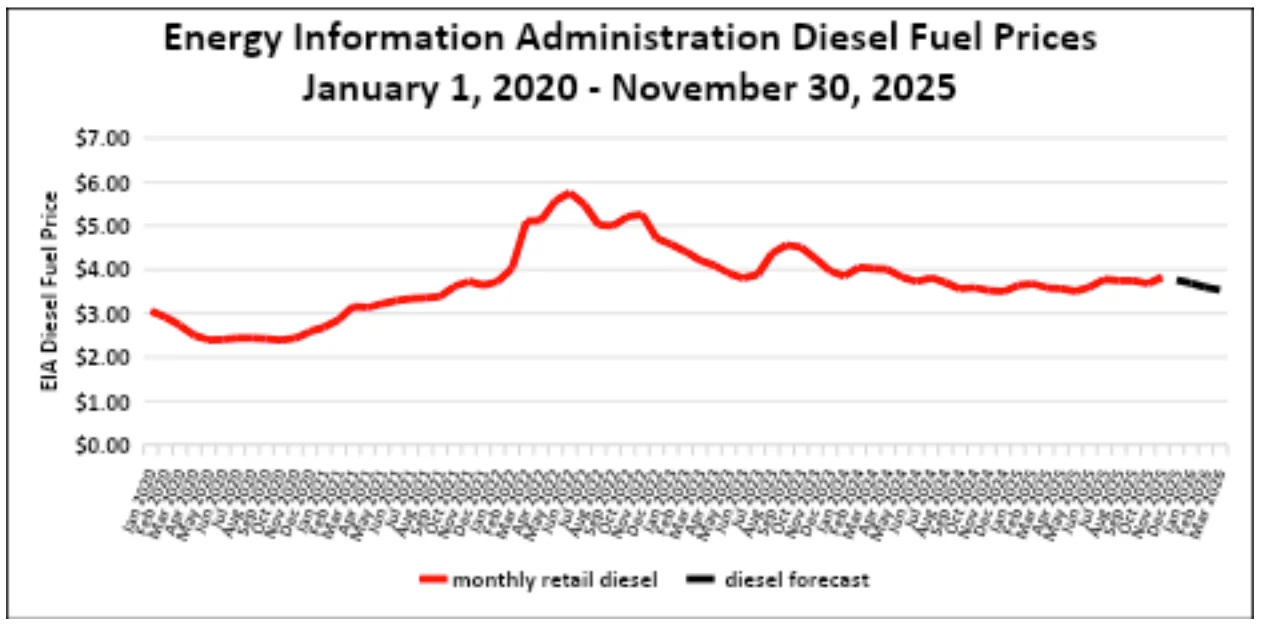
  • 2024 diesel fuel retail prices averaged $3.761/gallon through Q4 2024 and Q1 2025 finished lower at an average $3.631/gallon, and Q2 finished at $3.555/gallon.

  • Fuel for Q3 finished at $3.757/gallon and Q4 is tracking $3.753/gallon to close out 2025.

Energy Information Administration Diesel Fuel Prices January 1, 2020 - November 30, 2025

U.S. Diesel Fuel Prices and Forecast, 2020–2025 Line chart showing EIA monthly retail diesel prices rising from about $2.30 in 2020 to a $5.75 peak in 2022, then easing near $3.70 with a slight downward forecast through late 2025.

More
articles

Check claim status

To check the status of your claim, or to contact your claim representative, please click the confirmation status link that was sent via email when you filed the claim.

Make an Online Payment 

To make online payments, locate your personalized LockStep payment link sent to you from dlxar@shipdlx.com. If you need help, please contact DLX AR.

Submit an Invoice

Please send your invoice and all backup documents to: